The Most Popular RSA Jobs in Australia
May 15, 2026


Online course scams have gotten a lot harder to spot. The days of obvious, poorly built websites are largely gone. Scam providers now run professional-looking sites, use the right industry language, and in some cases copy government-style wording so closely that it’s genuinely hard to tell what’s real and what isn’t.
This affects anyone looking to get certified in Australia. Some of the most common courses are White Cards, RSA certificates, and food safety training. The risk isn’t just losing money to a dodgy provider. Training from an unregistered organisation has no legal standing in Australia. Employers won’t accept it, you can be turned away from job sites, and in some cases you can face legal consequences for working without a valid certification.
This guide gives you the practical tools to spot a fake, verify a legitimate provider, and make sure you only join a legitimate course.
Short courses are in high demand. Every builder needs a White Card, hospitality workers need RSA training, food industry workers need food handling certificates. Where there’s demand, scammers follow. The VET sector is a big market and short courses are an easy target.
Scam providers all follow the same playbook. Professional-looking websites, fake government logos, official-sounding language, and prices low enough to get your attention. They know exactly who they’re targeting: people who are busy and just want to get certified quickly.
Some take your money and disappear entirely. Others actually hand over some kind of learning material, but it leads nowhere because the provider isn’t registered and the certificate is worthless. Either way, you end up with nothing that any employer or regulator will accept.
Online training made this easier for scammers. A fake face-to-face training centre is hard to pull off. A fake website takes a few hours.
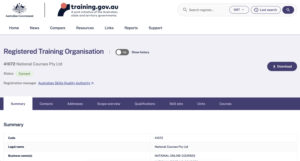
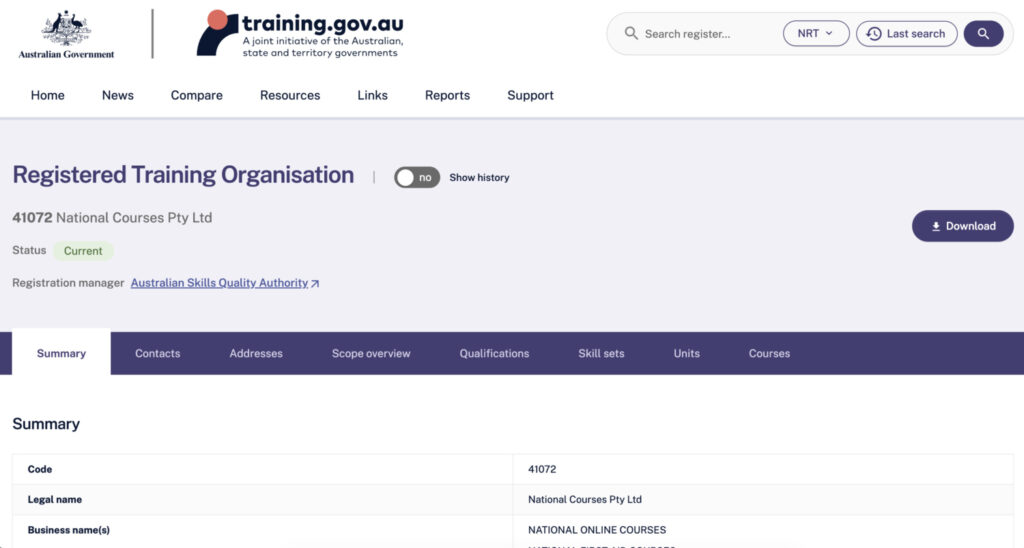
They’re not on training.gov.au This is the first thing to check, full stop. Every legitimate RTO in Australia is listed on the government website. If you search for the provider and nothing comes up, they’re not registered.
The price is suspiciously low. Legitimate courses cost what they cost because there are real compliance, staffing, and delivery costs behind them. If a White Card or RSA is going for a fraction of what everyone else charges, that’s a problem. Too cheap usually means unregistered.
You can finish the course quickly. A genuine White Card course has a minimum required duration set by law. Same goes for other regulated short courses. If a provider is promising completion in 1 hour or letting you skip through content, the certificate you get at the end might not be worth anything.
No RTO number anywhere on the site. Every registered training organisation has a unique RTO number. Legitimate providers display it clearly, usually in the footer or on the course page. If you can’t find one, that’s a serious red flag.
Their contact details don’t check out. No phone number, no physical address, or a contact form that goes nowhere. Legitimate providers are reachable. If you can’t find a real way to get in touch with someone, that tells you everything you need to know.

You can verify any Australian training provider’s legitimacy using the free and easily accessible tools available.
Here’s the exact way to verify if a provider is genuine before you enrol in any nationally recognised training course in Australia.
The National Register of Vocational Education and Training (VET) provides training.gov.au, which provides a comprehensive list of all active Registered Training Organisations (RTOs) in Australia.
You can visit the website, search for the training provider’s name or their RTO number to get the required details:
If you can’t find the provider, it means they are not a registered training institution and therefore cannot award any nationally recognised qualifications. Do not sign up for courses, make payments or share any personal details with them.
While being a registered RTO is important, in some cases, additional approvals from the state regulators may be required to run a particular course. For example, White Card training needs permission from the respective state’s occupational health and safety authorities, such as SafeWork NSW, WorkSafe QLD, WorkSafe WA, etc.
RSA courses require clearance from the state’s liquor licensing department. Check with the relevant state regulator to see if your preferred provider is part of their list of approved training providers.
In New South Wales, SafeWork NSW maintains a list of approved providers for white card training courses. Although a training provider can be a registered national RTO, it may not be allowed to provide specific courses in your state; it is necessary to carry out both checks.

All good training providers have clear contact details which are easily accessible. Try calling the phone number provided on their website. If no one answers and there is no option to leave a voice message, it raises some concerns.
Also, cross-verify the business address given on the website via Google Maps to confirm if it is a genuine business location or just a virtual office.
Good training providers, such as TAFEs, registered private training providers and approved online training organisations can be contacted easily and provide clear information about their areas of operation. Scammers often mask themselves behind contact pages that do not provide any information about them.
Do not rely on the testimonials available on the provider’s website itself. These could be fake. Look up the provider’s name on Google Maps and read its Google Reviews.
Check out their social media pages. Look out for detailed reviews mentioning specific trainers, course content or experiences – these are difficult to fake compared to general 5-star ratings.
No reviews at all is a cause for concern too. Reputable and authentic Registered Training Organisations (RTOs) providing training across Australia have a track record of obtaining feedback from students through various mediums.

You can check the provider’s name or RTO number on training.gov.au. If they are listed as an active RTO (a training organisation registered by the Australian Skills Quality Authority), they have the authority to provide nationally recognised certifications.
You must ensure that they also hold permission from your State’s relevant government department to provide the training you have chosen.
Whether you can get a refund depends on the mode of payment. If you paid through a credit card, contact your bank and ask them to initiate a chargeback. If you made a bank transfer, recovering your money would be challenging, but it is advisable to try.
Inform the scammers to report to Scamwatch through ACCC and the consumer protection department of your state. Prompt action increases your chances of recovering most of your money.
No, it isn’t. A White Card issued by an organisation that is not a registered RTO approved to deliver the CPCCWHS1001 unit is not a valid White Card.
It will not be accepted on any Australian construction site, and providing it may lead to legal issues.
First, check training.gov.au to confirm they’re not actually registered. Sometimes providers look dodgy but are legitimate. If they have an RTO number on their site, search it. If it doesn’t match or nothing comes up, then you’ve got a problem.
Try contacting the provider directly first. A legitimate business will respond. If you get nothing back, or the contact details don’t work at all, that’s your answer.
Once you’re sure it’s a scam, move fast. Call your bank straight away if you handed over payment details. Change any passwords you used on that site, especially if you reuse them elsewhere. Report the provider to Scamwatch at scamwatch.gov.au and to ASQA if they were posing as a registered RTO. If you think your identity has been compromised, contact IDCARE at idcare.org, which is Australia’s national identity and cybersecurity support service.

If you’re planning to work in Australia on a Working Holiday Visa, having your tickets and certifications ready is the easiest way to stand out and land work fast. National Online Courses makes it simple:
All courses are 100% online, nationally recognised and designed to get you job-ready quickly, no matter where you are.