7 Best FIFO and Mining Certificates That Will Get You Hired
June 29, 2026

If you’ve ever done a vocational course in Australia, got your White Card, completed your RSA, or studied at TAFE, you’ve already dealt with an RTO. You just might not have known it at the time.
RTOs are the backbone of skills-based education in Australia. They’re the only ones with the authority to issue nationally recognised qualifications. The kind that employers and regulators actually accept.
But what exactly is an RTO? How are they different from your average training provider? What does it take to become one, and what happens when things go wrong?
Required: To work on any construction site.
Time: ~6 hrs (Zoom + online)
Required: To serve alcohol legally in Australia.
Time: ~4–6 hrs (self-paced)
Required: For gaming/pokies venues in QLD, SA, NT.
Time: ~4 hrs (online)
Required: For handling food in commercial kitchens.
Time: ~3 hrs (online)
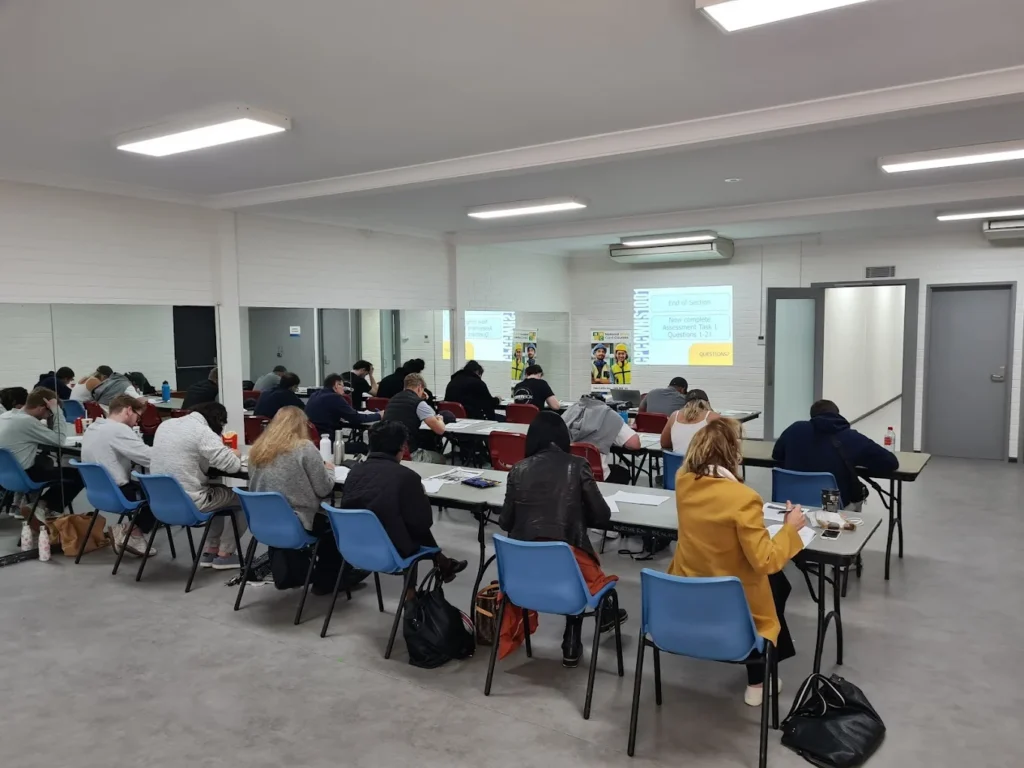
The term RTO stands for Registered Training Organisation. RTO is the term used to describe any institution that is registered to provide nationally recognized training and qualifications within Australia’s vocational education and training (VET) system.
Australia’s education system has two main parts. You’ve got universities, and then you’ve got the VET sector. Vocational Education and Training.
VET is all about practical skills. Think construction, hospitality, healthcare, retail, transport. Real-world stuff that gets you job-ready.
RTOs run the VET sector. They’re the ones delivering nationally recognised certificates, diplomas, and short courses. Every accredited vocational qualification in Australia, from the White Card to a Certificate IV in Building and Construction, has to go through an RTO. There are no exceptions.
The whole system sits under the Australian Qualifications Framework, or AQF. It sets the rules for what each qualification level actually means in terms of knowledge, skills, and how you apply them on the job.
RTOs are not limited to schools or training centres. Any of the following types of organizations can apply to become registered training providers in Australia, provided they meet the required standards:
Each one of them has completed the registration process, holds a valid RTO ID, and is allowed to deliver the training qualifications that feature on the Commonwealth register of VET.

Finding out about a good training provider is important before you start studying. There are many training providers operating throughout Australia, with some not complying with rules to provide low-cost or quick qualification options.
It’s important to find ways to identify genuine training providers. It takes just 2 minutes to do this and can help you save a lot of time and money.
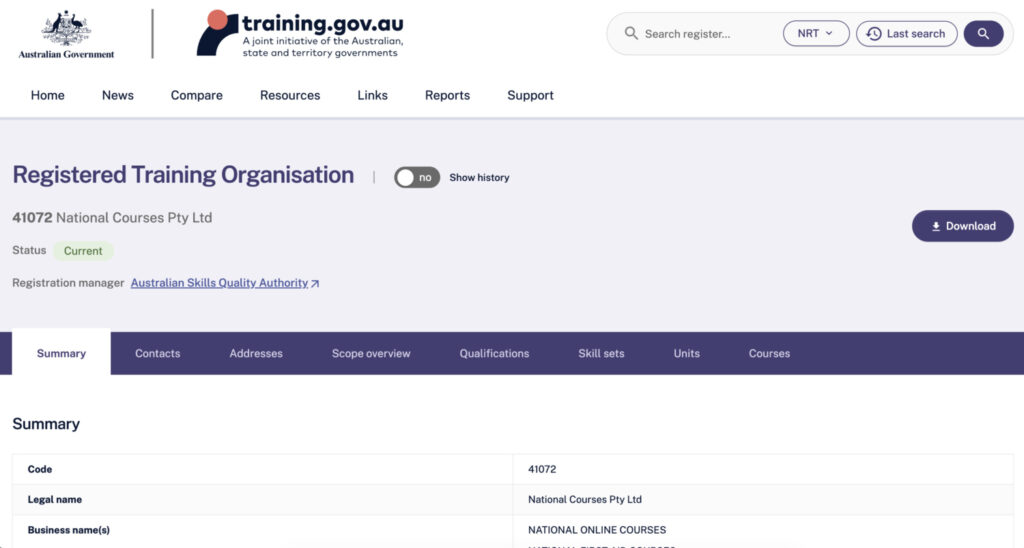
The Australian Training Register lists all the registered RTOs in Australia. Any training provider offering nationally recognized training qualifications should be listed on this register. Here’s how to find out:
National Online Courses (RTO 41072) is a Registered Training Organisation listed on the Australian Training Register and approved by various state authorities (including SafeWork NSW, WorkSafe QLD, WorkSafe Tasmania & WorkSafe WA).
We provide nationally recognized training courses, including White Card courses, RSA, RSG & Food Safety training online.
There are signs to look out for. You should be concerned if a training provider:
Qualifications obtained from unregistered training providers have no national recognition.
Employers will not accept them, and you will not have any legal protection when working on a construction site. The few minutes taken to check the status of a training provider on is time well spent.
Not every RTO offers the same courses. Each one is registered to deliver specific qualifications and units. Some only cover a handful of short courses, others span multiple industries.
Short programs like the White Card or RSA certificate sit within the AQF but are delivered separately from full qualifications.
As long as an RTO is approved to deliver them, they’re nationally recognised. And these aren’t niche, millions of workers across Australia need them to meet industry requirements.

Understand that the system of accountability provides important context for what it really means to be a registered training provider.
Registry approval is not simply a formality. Regular, detailed observation and consequences for failing to follow rules are central to keeping the system effective.
ASQA (the Australian Skills Quality Authority) is the body that oversees RTOs nationwide. It registers providers, sets compliance standards, runs audits, and takes action when things go wrong.
Most states fall under ASQA, but Victoria and Western Australia run their own systems. Victoria has the Training and Tertiary Education Commission, WA has the Training Accreditation Council. RTOs operating across multiple states usually answer to ASQA regardless.
Every RTO has a unique registration number. You can search any provider on training.gov.au to check if they’re registered, what they’re approved to deliver, and where.
RTOs have to follow the Standards for Registered Training Organisations 2015 — eight areas covering everything that matters:
Training and assessment quality
Trainer qualifications and up-to-date industry knowledge
Student support
Honest marketing and enrolment practices
Governance and financial management
Record keeping and national data reporting
Compliance with privacy and anti-discrimination laws
Ongoing quality improvement
Break these standards and you’re looking at conditions on your registration, disciplinary action, suspension, or cancellation. ASQA publishes all enforcement actions publicly, so students and employers can check a provider’s track record before signing up.

If you’re planning to work in Australia on a Working Holiday Visa, having your tickets and certifications ready is the easiest way to stand out and land work fast. National Online Courses makes it simple:
All courses are 100% online, nationally recognised and designed to get you job-ready quickly, no matter where you are.